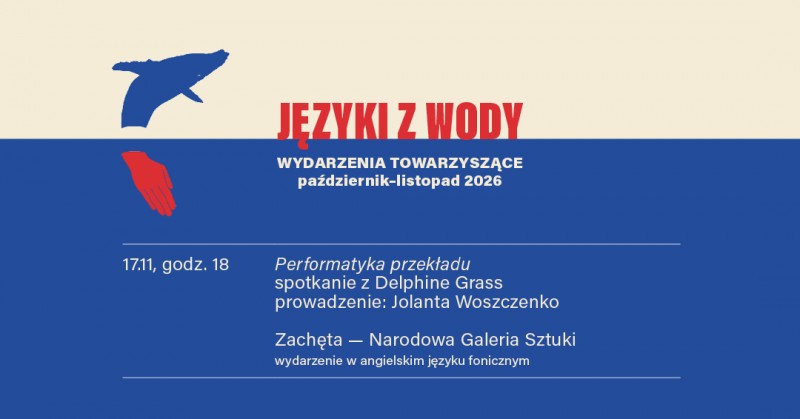
Performatyka przekładu: spotkanie z Delphine Grass
Zachęta | entrance from ul. Burschego (down the stairs)
free entry
17
entrance free
an event in English translation for PJM – we request you submit your requirements at: polonia@labiennale.art.pl at least a week before the event
The Liquid Tongues installation by Bogna Burska and Daniel Kotowski is being presented at the Polish Pavilion of the 61st International Art Exhibition in Venice until 22 November. In order to familiarise Polish audiences with the project, we’re hosting a series of meetings in Warsaw this autumn.
During the meeting with Delphine Grass, we will be speaking about translation and its alleged neutrality. Translation is not a simple transfer of meaning – it always partly creates differences between languages, cultures and worlds, and as such, it can reinforce existing hierarchies or open spaces for new communities. A source of our culture’s phonocentrism is the conviction that human phonic speech is the basic or highest model of communication, which historically led to the marginalisation of both sign languages and animal communications. It thus seems less interesting to seek out simple correspondences – for instance, whether animals have languages analogous to human ones – than to consider how we might expand our understanding of language to include other ways of communicating, in other species, for instance, to break down our cognitive formulae.
Liquid Tongues is a project in which the social Choir in Motion, made up of both hearing and Deaf people, interpret whale communication codes and songs in English phonic and international sign (IS) languages, building a visual-spatial-audio fantasia on possible translations. Moving between human and non-human, phonic and visual languages, Liquid Tongues produces a space ‘in-between’ that is inherently fluid. Translation attempts become a performative act, a tool of the imagination, allowing for the anthropocentric perspective to be questioned and encouraging us to change how we think about communication.
The meeting will be held by Jolanta Woszczenko, a curator of Liquid Tongues.
About our guests:
Delphine Grass – a senior lecturer in French and comparative literature at Lancaster University, where she serves as the head researcher in a project called Animals in Translation: AI, Ethics and the Future of Interspecies Dialogue, financed by AHRC/BRAID. Her research focuses on the intersection between critical/creative practices in translation, the environmental humanities and digital media. Her most recent publications include: Translation as Creative-Critical Practice and Unending Translation: Creative-Critical Experiments in Translation and Life Writing (soon to be released). She is a multilingual poet and translator.
Jolanta Woszczenko – co-creator of the Liquid Tongues exhibition. Contemporary art curator, affiliated with the Gdańsk Centre for Contemporary Art since 2008. She is interested in experimental forms of film and video, and communication processes, both between the artist and the viewer and the media and fields of art.
More on Liquid Tongues: https://labiennale.art.pl/en/wystawy/jezyki-z-wody/
Delphine Grass’s article ‘Producing a Common World: Liquid Tongues and the Radical Art of Interspecies Translation’ is found in the publication accompanying the Liquid Tongues exhibition.
The organiser of the Polish Pavilion at the Venice Biennale Zachęta – National Gallery of Art.
The events programme accompanying the Liquid Tongues exhibition was financed by the PKO Bank Polski Foundation.
Poland’s participation in the 61th International Art Exhibition — La Biennale di Venezia is made possible through the financial support of the Ministry of Culture and National Heritage of the Republic of Poland:

patron of the Polish Pavilion:
main partner of the exhibition:

partners of the exhibition:


supported by:

media patronage: